Stepping into the vast world of fishing can be as exhilarating as it is overwhelming, especially when faced with the fundamental choice between spinning and baitcasting rods. These two primary rod and reel setups, while both designed to land fish, operate on fundamentally different principles and cater to distinct angling styles. For newcomers and seasoned pros alike, understanding these differences is crucial for maximizing your success and enjoyment on the water in 2026. This comprehensive guide will break down the nuances of spinning and casting rods, explore other popular rod types, and equip you with the knowledge to select the perfect rod for your fishing adventures.
Popular Types of Fishing Rods
The diversity in fishing techniques has led to a wide array of rod designs, each optimized for specific applications. While our focus is on spinning and baitcasting, a quick overview of other common types provides context for the vast landscape of angling gear.
Spinning Rods
Spinning rods are perhaps the most recognizable to the general public, characterized by their reel mounted underneath the rod handle and larger line guides facing downwards. When casting, the line peels off a stationary spool, making the process intuitive and forgiving.
- Advantages: Spinning rods are exceptionally easy to learn and use, making them ideal for beginners. They excel at casting lightweight lures (typically under 1/4 ounce), finesse techniques, and live bait applications. Their design minimizes tangles and backlashes, and they perform well in windy conditions due to the line freely leaving the spool. The fixed spool allows for good casting distance with lighter baits.
- Disadvantages: Compared to baitcasting setups, spinning rods generally offer less casting accuracy for pinpoint presentations. Their drag systems can be weaker, making them less suited for power fishing or handling exceptionally large, hard-fighting fish in heavy cover.
- When to Use: Choose a spinning rod if you are new to fishing, prefer using light lures and finesse presentations (like drop-shotting or wacky rigs), or need to cast in open water and windy conditions. They are excellent for panfish, trout, and light bass fishing.
|
Our Picks for the Best Fishing Rod in 2026
As an Amazon Associate I earn from qualifying purchases.
|
||
| Num | Product | Action |
|---|---|---|
| 1 | PLUSINNO Fishing Rod and Reel Combos Carbon Fiber Telescopic Fishing Pole with Reel Combo Sea Saltwater Freshwater Kit Fishing Rod Kit |

|
| 2 | PLUSINNO Fishing Rod and Reel Combos Carbon Fiber Telescopic Fishing Pole with Reel Combo Sea Saltwater Freshwater Kit Fishing Rod Kit |
|
| 3 | OKUMATrout Rod |
|
| 4 | PLUSINNO Fishing Rod and Reel Combos Carbon Fiber Telescopic Fishing Pole with Reel Combo Sea Saltwater Freshwater Kit Fishing Rod Kit |
|
| 5 | Shakespeare Micro Spinning Rod |
|
| 6 | Sougayilang Fishing Rod Reel Combo with Telescopic Fishing Pole Spinning Reel Carrier Bag for Travel Saltwater Freshwater Fishing |
|
| 7 | PLUSINNO Fishing Rod and Reel Combos - Carbon Fiber Telescopic Fishing Pole - Spinning Reel 12 +1 Shielded Bearings Stainless Steel BB |
|
| 8 | Fishing Rod, 6.9ft 2Pcs Telescopic Fishing Rods Set, Carbon Fiber Fishing Pole, 2PCS Spinning Rod and Reel Combo with Carrier Bag Freshwater Fishing Rod and Reel Combos Kits Fishing Gear |
|
| 9 | PLUSINNO Fishing Gear,Full Fishing kit Include Fishing Rod and Reel Combo, Tackle Box with Fishing Lures, Fishing Accessories, Fishing Pliers,Fishing Gifts for Men with Fishing Tool Kit |
|
| 10 | PLUSINNO Fishing Rod and Reel Combos - Carbon Fiber Telescopic Fishing Pole - Spinning Reel 12 +1 Shielded Bearings Stainless Steel BB |
|
Baitcasting Rods
Often referred to simply as casting rods, these feature a reel that sits on top of the rod handle, with smaller line guides facing upwards. Unlike spinning reels, the spool of a baitcasting reel rotates during the cast, requiring a different casting technique.
- Advantages: Baitcasting rods offer superior accuracy and control once mastered, allowing anglers to place lures precisely near structure or cover. They are built for heavier lures (typically 1/4 ounce and up), stronger lines, and power fishing techniques such such as flipping, pitching, and frogging. Their robust drag systems are better suited for targeting larger, more powerful fish like big bass, pike, muskie, and various saltwater species.
- Disadvantages: Baitcasting rods have a steeper learning curve and require significant practice to avoid “backlash” or “bird’s nest” tangles, where the line spools faster than the lure leaves the rod. They are generally more expensive than comparable spinning setups.
- When to Use: Opt for a baitcasting rod if you are an experienced angler seeking maximum precision and power, frequently use heavier lures, fish in heavy cover, or target substantial fish species.
Fly Rods
Fly rods are a specialized category designed for fly fishing, a technique that uses a heavy line to cast a nearly weightless “fly” lure. These rods are incredibly flexible and work in conjunction with unique fly reels that store the line but aren’t typically used for casting.
- Advantages: Unmatched for presenting delicate, lifelike imitations of insects or small baitfish. Excellent for targeting highly selective fish in clear water.
- Disadvantages: Highly specialized, with a unique casting technique that requires significant practice. Not suitable for traditional lure or bait fishing.
- When to Use: Exclusively for fly fishing for species like trout, salmon, or specific warm-water species in appropriate environments.
Surf Rods
Surf rods are long, robust rods specifically designed for casting heavy baits and lures far out into the ocean surf from beaches, piers, or jetties.
- Advantages: Extreme casting distance with heavy weights, capable of handling large saltwater species and strong currents. Built for durability in harsh coastal environments.
- Disadvantages: Very long and heavy, making them unwieldy for smaller fish or in confined spaces. Lack sensitivity for subtle bites.
- When to Use: When fishing from the shore in saltwater, targeting species like striped bass, red drum, or shark that require long casts and heavy tackle.
Comparing Spinning and Baitcasting Rods
Deciding between a spinning and baitcasting rod often comes down to personal preference, target species, and the techniques you plan to employ. Here’s a detailed comparison to help clarify their roles:
| Feature | Spinning Rods | Baitcasting Rods |
|---|---|---|
| Ease of Use | Very easy, ideal for beginners | Requires practice, steeper learning curve |
| Accuracy | Good for general casting, less precise | Excellent for pinpoint precision and targeting |
| Casting Distance | Great for lightweight lures, especially in wind | Can achieve longer casts with heavier lures, powerful |
| Lure Weight | Best for light lures (under 1/4 oz) | Excels with heavier lures (1/4 oz and up) |
| Target Fish | Panfish, trout, light bass, smaller species | Large bass, pike, muskie, saltwater species |
| Backlash Risk | Very low | High if not properly controlled with thumb |
| Drag System | Generally weaker | Stronger, better for fighting large fish |
| Finesse Fishing | Excellent for delicate presentations | Less suited for ultra-finesse techniques |
| Power Fishing | Less ideal | Dominant for flipping, pitching, heavy cover |
| Price | Generally more affordable for beginners | Often more expensive for quality setups |
> “While spinning rods are the go-to for beginners and finesse applications, mastering a baitcaster unlocks a level of precision and power that’s simply unparalleled for targeting larger, aggressive fish in tight spots.” – Capt. Mark Johnson, Professional Angler and Fishing Guide
Key Factors When Choosing Your Fishing Rod (Buying Guide)
Beyond the spinning vs. baitcasting debate, several universal characteristics define a rod’s performance. Understanding these elements is crucial for selecting a rod that truly fits your needs.
Rod Length
The length of a fishing rod significantly influences casting distance, accuracy, and leverage.
- Shorter rods (5-7 feet): Ideal for tight spaces, accurate shorter casts, and when quick, precise movements are needed. They offer more control and are often preferred for techniques like pitching and flipping in heavy cover.
- Longer rods (8-12+ feet): Excel in open areas where maximum casting distance is desired. They provide more leverage for fighting larger fish and absorb shock better, reducing the chance of pulling the hook. However, they are less accurate for pinpoint casts.
Choose a length that suits your typical fishing environment and the casting techniques you’ll employ.
Rod Material
The material of a rod blank dictates its weight, sensitivity, durability, and action. The most common materials are fiberglass, graphite, and composite.
- Fiberglass:
- Pros: Highly durable, flexible, and relatively inexpensive. Their forgiving “slow” action helps keep fish hooked, especially with treble-hooked lures or for beginners. They can withstand considerable abuse.
- Cons: Heavier, less sensitive, and offer less feedback compared to graphite, making subtle bites harder to detect.
- Graphite:
- Pros: Lightweight, highly sensitive, allowing anglers to feel even the slightest bites. Offers a “fast” action for quick hook sets and excellent control. Available in longer lengths for improved reach and accuracy. Different modulus ratings (e.g., IM6, IM8) indicate stiffness; higher modulus means a lighter rod for the same stiffness.
- Cons: More brittle and prone to breakage if mishandled compared to fiberglass. Generally more expensive.
- Composite:
- Pros: A blend of fiberglass and graphite, composite rods aim to capture the best of both worlds. They offer a good balance of durability, sensitivity, and flexibility. Versatile and often a good middle-ground choice for various fishing styles.
- Cons: Price can vary widely, sometimes being more expensive than single-material rods. Their performance characteristics depend heavily on the specific blend ratio.
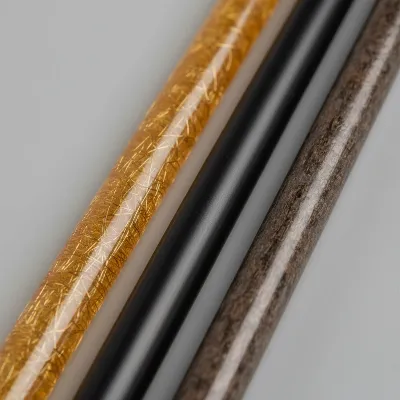 Close-up of fishing rod blanks made of fiberglass, graphite, and composite materials
Rod Power (Strength)
Rod power refers to the amount of force required to bend the rod blank. It dictates how much backbone a rod has and what size line and lure it can effectively handle.
- Ultra-Light (UL): Designed for tiny lures, light lines, and small fish (e.g., panfish, trout). Extremely sensitive.
- Light (L): Suitable for light lures and lines, often used for crappie, small bass, or finesse techniques.
- Medium (M): A versatile power for a wide range of lures and fish. Good for general bass fishing, walleye, and medium-sized freshwater species.
- Medium-Heavy (MH): Provides more backbone for heavier lures, stronger lines, and fighting larger fish or fishing in heavier cover. Excellent for jigging, Texas rigging, and larger bass.
- Heavy (H) & Ultra-Heavy (XH): Specialized for the largest lures, heaviest lines, and powerful fish (e.g., muskie, trophy pike, large saltwater species). Essential for situations requiring maximum power.
Always match the rod’s power to the weight of your lure and the size of the fish you anticipate catching.
Rod Action (Flexibility)
Rod action describes where the rod bends when pressure is applied to the tip. It influences casting distance, accuracy, and hook-setting ability.
- Slow Action: The rod bends throughout its entire length, creating a deep, parabolic curve. It’s very forgiving, helps keep fish hooked, and is excellent for casting lighter lures or when using treble hooks. However, it’s less sensitive and has slower hook sets.
- Moderate (or Medium) Action: The rod bends in the upper half to two-thirds. Offers a good balance of casting distance, hook-setting power, and fish-fighting leverage. A versatile choice for many techniques.
- Fast Action: The rod bends primarily at the tip. Provides maximum sensitivity for detecting subtle bites and allows for quick, powerful hook sets. Ideal for single-hook lures, jigging, and working baits with precision. Less forgiving with light lines.
Reel Seat and Handle
The reel seat securely fastens your reel to the rod, while the handle provides your grip.
- Reel Seat: Look for a durable, securely locking reel seat that holds your chosen reel firmly.
- Handle Materials: Most handles are made from cork or EVA foam. Cork offers a traditional feel and excellent grip, even when wet, but can be more prone to wear. EVA foam is durable, lightweight, and often more affordable, providing a comfortable, non-slip grip.
- Handle Length: Varies based on rod type and intended use. Longer handles provide better leverage for two-handed casting or fighting large fish, while shorter handles are good for single-handed casting and close-quarters fishing.
Rod Guides
Rod guides are the rings along the rod blank that channel the fishing line from the reel to the tip. Quality guides are crucial for casting performance, line management, and durability.
- Material: Modern guides often feature ceramic or silicon carbide (SiC) inserts. These materials are smooth, hard, and resistant to wear, minimizing friction on your line and allowing for longer, smoother casts.
- Number and Placement: The number and strategic placement of guides help distribute stress evenly across the rod blank when fighting a fish, preventing weak spots and increasing the rod’s strength and casting accuracy.
Selecting the Right Rod for Your Style
Choosing the “best” rod isn’t about finding a single universal answer, but rather the right tool for your specific needs and preferences.
- For Beginners: A medium-power, fast-action spinning rod (6’6″ to 7′) is often recommended. It’s versatile, easy to learn, and can handle a wide range of lures and fish species, providing a solid foundation for developing skills.
- For Experienced Anglers: Consider adding a medium-heavy or heavy power baitcasting rod (6’8″ to 7’6″) with a fast or extra-fast action. This will open up opportunities for power fishing techniques, targeting larger fish, and achieving unparalleled accuracy with heavier baits. Many experienced anglers own both types, optimizing their tackle for different situations.
- Technique-Specific Choices:
- Finesse fishing (e.g., drop shot, Ned rig): Light to medium-light power, fast action spinning rod.
- Jigging/Texas rigging: Medium-heavy power, fast action baitcasting rod for sensitivity and hook-setting power.
- Crankbaits/Chatterbaits (treble hooks): Medium-moderate action fiberglass or composite rod to prevent pulling hooks.
- Topwater: Medium-power, fast action spinning or baitcasting rod for quick twitching.
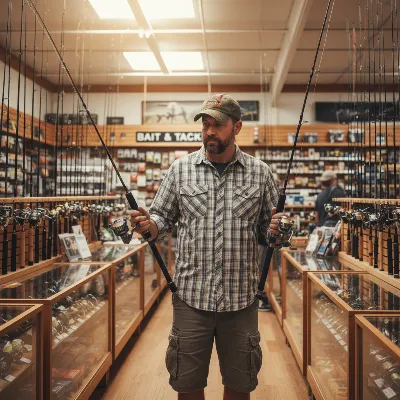 An angler thoughtfully examining a selection of spinning and baitcasting rods in a tackle shop
The world of fishing gear is constantly evolving, with new materials and technologies enhancing rod performance. As we look towards 2026, advancements in blank construction, guide materials, and ergonomic handle designs continue to push the boundaries of what’s possible, offering lighter, more sensitive, and incredibly durable rods. By understanding the core principles of rod design and matching them to your angling aspirations, you’ll be well-prepared to make an informed choice.
Conclusion
The debate between spinning and baitcasting fishing rods isn’t about one being definitively “better” than the other; rather, it’s about identifying which setup aligns with your skill level, target species, and preferred fishing techniques. Spinning rods shine in their ease of use and ability to handle lightweight lures with minimal fuss, making them an excellent starting point for any angler. Baitcasting rods, while requiring more skill to master, offer unmatched precision and power for tackling larger fish and heavier cover with confidence.
Ultimately, the best approach for 2026 and beyond is to consider your individual fishing style. Beginners often find more immediate success and enjoyment with a versatile spinning setup, while experienced anglers frequently employ both types, switching between them to optimize for specific conditions and presentations. Don’t be afraid to experiment, and remember that the right rod is the one that feels most comfortable and effective in your hands, helping you create unforgettable memories on the water.
Frequently Asked Questions
What is the main difference between a spinning rod and a casting rod?
The main difference lies in the reel’s position and how the line leaves the spool. A spinning reel sits underneath the rod with a fixed spool, allowing line to unspool easily. A casting reel sits on top, and its spool rotates, requiring thumb control to prevent tangles and achieve precise casts.
Which fishing rod is better for beginners?
Spinning rods are generally better for beginners due to their ease of use, simpler casting technique, and reduced risk of backlashes. This allows new anglers to focus more on fishing and less on managing their gear.
Can I use a spinning reel on a casting rod, or vice versa?
No, spinning reels and casting reels are designed to be used with their respective rod types. The guide placement, reel seat, and overall rod construction differ significantly between spinning and casting rods to accommodate the specific mechanics of each reel.
What does “rod power” mean?
Rod power refers to the rod’s strength or its lifting ability, indicating how much weight it can handle before bending significantly. It’s often classified as ultra-light, light, medium, medium-heavy, heavy, or ultra-heavy, and should be matched to the line weight and target fish size.
How does rod action affect fishing?
Rod action describes where a rod bends along its length. Fast action rods bend only at the tip, offering high sensitivity and quick hook sets. Slow action rods bend throughout their entire length, providing more forgiveness and better shock absorption, which is ideal for treble hooks.
Is graphite or fiberglass better for fishing rods?
Neither is inherently “better”; it depends on the application. Graphite rods are lighter and more sensitive, favored for finesse fishing and quick hook sets. Fiberglass rods are more durable, flexible, and forgiving, excellent for beginners, crankbaits, or when durability is a priority.
What rod length should I choose for general fishing?
For general-purpose fishing, a rod length between 6’6″ and 7′ is often recommended. This range offers a good balance of casting distance, accuracy, and versatility for various techniques and environments, making it a popular choice for many anglers.
