The crashing waves, the salty air, and the exhilarating pull of a strong fish on the line – surf casting offers an unparalleled angling experience. But to truly master the art of fishing from the shore, selecting the right saltwater surf casting rod is paramount. A well-chosen rod doesn’t just enable longer casts; it provides the sensitivity to detect subtle bites, the backbone to battle powerful ocean predators, and the durability to withstand the harsh marine environment. With countless options available, understanding the nuances of rod design is crucial to elevate your success and enjoyment on the beach. This comprehensive guide will equip you with the knowledge to pick the perfect surf casting rod for your 2026 adventures, exploring different types, essential features, and top recommendations.
Types of Saltwater Fishing Rods for Surf Casting
When heading to the surf, you’ll encounter a few primary rod types, each with specific strengths. While the term “surf rod” often refers to a specialized long-casting tool, spinning and baitcasting setups also play significant roles depending on your technique and target species.
Surf Rods
|
Our Picks for the Best Fishing Rod in 2026
As an Amazon Associate I earn from qualifying purchases.
|
||
| Num | Product | Action |
|---|---|---|
| 1 | Shakespeare Micro Spinning Rod |

|
| 2 | OKUMATrout Rod |
|
| 3 | PLUSINNO Fishing Rod and Reel Combos Carbon Fiber Telescopic Fishing Pole with Reel Combo Sea Saltwater Freshwater Kit Fishing Rod Kit |
|
| 4 | PLUSINNO Fishing Rod and Reel Combos - Carbon Fiber Telescopic Fishing Pole - Spinning Reel 12 +1 Shielded Bearings Stainless Steel BB |
|
| 5 | PLUSINNO Fishing Rod and Reel Combos Carbon Fiber Telescopic Fishing Pole with Reel Combo Sea Saltwater Freshwater Kit Fishing Rod Kit |
|
| 6 | PLUSINNO Fishing Rod and Reel Combos Carbon Fiber Telescopic Fishing Pole with Reel Combo Sea Saltwater Freshwater Kit Fishing Rod Kit |
|
| 7 | PLUSINNO Fishing Gear,Full Fishing kit Include Fishing Rod and Reel Combo, Tackle Box with Fishing Lures, Fishing Accessories, Fishing Pliers,Fishing Gifts for Men with Fishing Tool Kit |
|
| 8 | PLUSINNO Fishing Rod and Reel Combos - Carbon Fiber Telescopic Fishing Pole - Spinning Reel 12 +1 Shielded Bearings Stainless Steel BB |
|
| 9 | Sougayilang Fishing Rod Reel Combo with Telescopic Fishing Pole Spinning Reel Carrier Bag for Travel Saltwater Freshwater Fishing |
|
| 10 | Fishing Rod, 6.9ft 2Pcs Telescopic Fishing Rods Set, Carbon Fiber Fishing Pole, 2PCS Spinning Rod and Reel Combo with Carrier Bag Freshwater Fishing Rod and Reel Combos Kits Fishing Gear |
|
Dedicated surf rods are engineered for the unique challenges of casting from the coastline. These rods are inherently longer and more powerful than standard fishing rods, designed to propel heavy baits and lures far beyond the breaking waves where game fish often feed. Their robust construction allows them to endure the corrosive saltwater and the immense strain of fighting large fish amidst strong currents. Surf rods are your go-to for open beaches, jetties, and situations demanding maximum casting distance and lifting power.
Spinning Rods
Spinning rods are a highly versatile and popular choice for surf casting, particularly favored by beginners due to their user-friendly nature. They pair with spinning reels, which are generally easier to cast and manage, reducing the likelihood of tangles. For surf fishing, spinning rods are ideal for casting various lures and baits, from small jigs to medium-sized plugs. They excel in all-around surf fishing scenarios and are a solid option for anglers who frequently cast and retrieve, targeting a wide range of species from striped bass to bluefish.
Baitcasting Rods
Baitcasting rods, used with baitcasting reels, offer experienced anglers increased power, accuracy, and control. While they have a steeper learning curve compared to spinning setups, mastering a baitcaster can provide superior performance when targeting very large fish or needing precise lure placement with heavy baits. These rods are often chosen for their ability to handle heavier line weights and deliver substantial lifting power, making them effective for precision casting and situations where brute strength is required.
Comparing Saltwater Fishing Rods for Surf Casting
Understanding the differences between rod types and their characteristics is key to making an informed decision. The table below provides a quick comparison of essential factors for surf casting.
| Feature | Surf Rods (Specialized) | Spinning Rods (Surf Context) | Baitcasting Rods (Surf Context) |
|---|---|---|---|
| Length Range | 9-15 feet (typically 10-12 ft most common) | 9-11 feet (often on the longer side for surf) | 9-12 feet |
| Typical Power | Medium-Heavy to Heavy | Medium to Medium-Heavy | Medium-Heavy to Heavy |
| Typical Action | Moderate-Fast to Moderate | Moderate-Fast to Fast | Fast to Moderate-Fast |
| Best for | Max casting distance, heavy baits/rigs, rough surf | Versatility, various lures/baits, easier casting, beginners | Power, accuracy, heavier lures/fish, experienced anglers |
| Suitable Fish | Striped bass, red drum, large bluefish, sharks | Striped bass, bluefish, fluke, smaller drum | Large striped bass, drum, bull reds, sharks |
| Ideal Env. | Open beaches, jetties, inlets, heavy currents | All-around surf, back bays, less heavy conditions | Open beaches, heavy structure, precision casting scenarios |
| Learning Curve | Moderate (due to length/power) | Low (beginner-friendly) | High (requires practice to prevent backlashes) |
Key Factors When Choosing a Saltwater Surf Casting Rod
Selecting the ideal surf rod involves a careful consideration of several technical specifications. These elements directly impact your casting performance, sensitivity, and ability to land fish.
Rod Length
The length of your surf rod significantly influences both casting distance and control. Longer rods, typically 11 to 12 feet, provide greater leverage, allowing you to cast heavier baits and lures further, essential for reaching fish beyond the breaking waves or in strong currents. However, these longer rods can be more cumbersome to handle, especially for shorter individuals or during prolonged casting sessions. Shorter rods, in the 9 to 10-foot range, offer enhanced versatility, easier maneuverability, and less fatigue, making them excellent for frequent casting in back bays, inlets, or when targeting species closer to shore. For specialized applications like snap jigging close to the water’s edge, even shorter rods (6-8 feet) can be effective.
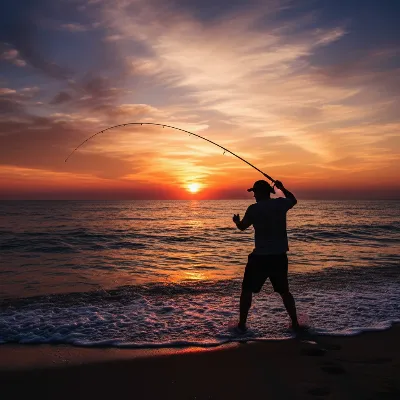 An angler powerfully casting a long surf rod into the ocean at sunrise.
Rod Material
The material composition of a fishing rod is a critical determinant of its performance, weight, sensitivity, and durability.
- Fiberglass: Renowned for its strength and flexibility, fiberglass rods are exceptionally durable and can withstand significant abuse in harsh conditions. They are often more affordable, making them a good choice for beginners or those on a budget. However, fiberglass rods tend to be heavier and less sensitive than their graphite counterparts, which can make detecting subtle bites challenging.
- Graphite: Lightweight and highly sensitive, graphite rods offer excellent casting performance and superior bite detection. They are stiffer, allowing for quicker hook sets and more precise lure presentations. High-modulus graphite delivers maximum sensitivity but can be more prone to breakage if mishandled. Brands like St. Croix utilize advanced carbon fiber technologies, such as SCII, to enhance both strength and lightness.
- Composite: Many modern surf rods utilize composite blanks, blending fiberglass and graphite. This combination aims to harness the best attributes of both materials, offering a balance of durability, sensitivity, and casting power. Composite rods are often a versatile choice, providing resilience without sacrificing too much feel.
Rod Power (Strength/Stiffness)
Rod power refers to the rod’s stiffness or backbone, indicating how much force it takes to bend the blank. It dictates the rod’s lifting capability and its ability to handle different lure and line weights.
- Light/Ultralight: Suitable for smaller fish and very light lures, typically not ideal for surf casting.
- Medium: Versatile for a range of fish sizes and lure weights.
- Medium-Heavy: A popular choice for surf casting, offering a good balance of power for casting medium-heavy baits and fighting decent-sized fish.
- Heavy/Extra-Heavy: Essential for targeting large, powerful species (like sharks or bull red drum) and for casting very heavy rigs in strong currents.
For most surf casting applications, a rod with medium to heavy power is recommended to effectively cast substantial baits and tackle the large fish encountered in the surf zone. A rod designed to cast weights between 2–6 ounces provides a versatile starting point for many anglers.
Rod Action (Flex)
Rod action describes where along the blank the rod flexes or bends under pressure, influencing casting distance, accuracy, and fish-fighting dynamics.
- Fast Action: These rods bend primarily in the top one-third of the blank. They offer superior sensitivity, allowing you to feel even the most subtle bites, and facilitate quick, powerful hook sets. Fast action is excellent for precision casting with lighter lures but can be less forgiving with hard-running fish and may cause poorly aerodynamic baits to tumble.
- Moderate Action: A moderate action rod bends through the middle section, creating a more parabolic curve. This action excels at loading energy for long-distance casting, effectively absorbing the shock of powerful fish runs, which can prevent pulled hooks. It strikes a good balance between sensitivity and fighting power.
- Slow Action: These rods bend closer to the butt section, providing a deeper, more uniform bend throughout the blank. Slow action rods are often used for techniques that require a more gentle presentation or for battling extremely large fish where a shock-absorbing flex is crucial, though they typically sacrifice casting accuracy and sensitivity.
For all-around surf casting, a moderate-fast to moderate action is often preferred, as it blends the benefits of distance casting with effective fish-fighting control.
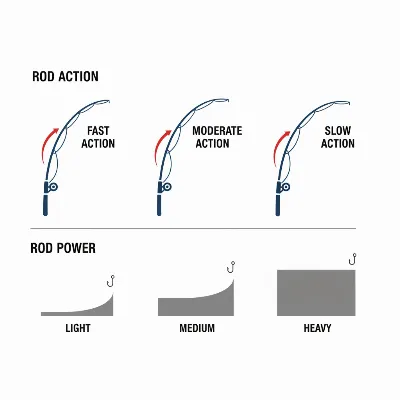 An infographic illustrating different fishing rod actions (fast, moderate, slow) and powers (light, medium, heavy).
Reel Seat and Guides
The quality and design of a rod’s components are crucial for its longevity and performance in saltwater. A durable, corrosion-resistant reel seat is vital to securely hold your reel under immense pressure. Look for features like Fuji’s back-stop reel seat, which uses a lock nut to prevent loosening.
Guides are equally important as they manage the line flow during casting and fighting fish. High-quality guides with ceramic inserts, such as Fuji FazLight Tanglefree, SiC (Silicon Carbide), or Alconite, are essential. These materials reduce friction, allowing for longer, smoother casts and protecting your line from wear and tear, especially with braided lines. Properly spaced and aligned guides ensure optimal energy transfer through the rod blank.
Handle and Grip
The handle of a surf rod plays a significant role in comfort and fatigue reduction, particularly during long hours of casting and battling fish. Common materials include EVA foam, cork, and dense polymer grips like Winn grips. EVA foam and Winn grips offer excellent traction even when wet, while cork provides a classic feel and good sensitivity. The length and ergonomic design of the handle should allow for comfortable two-handed casting and provide sufficient leverage during a fight.
Top Saltwater Surf Casting Rods for 2026 (Examples)
While individual preference and specific fishing conditions will always dictate the “best” rod, several models consistently earn high praise from surf casting enthusiasts for their performance and durability.
- St. Croix Seage Surf Spinning Rod: Often considered a gold standard, the Seage series is celebrated for its blend of strength, durability, and lightweight design. Utilizing advanced SCII carbon fiber, it offers impressive flexural strength and impact protection, making it a favorite for striped bass and other hard-fighting species. Many anglers note its balanced feel and precision casting capabilities.
- St. Croix Triumph Surf Rod: This rod strikes an excellent balance of performance, quality, and value. Made from SCI mid-modulus graphite fiber, the Triumph series is lightweight, durable, and sensitive. It’s an ideal choice for a wide range of surf anglers, offering premium features at a manageable price point and making long-distance casting accessible even for beginners.
- PENN Carnage III Surf Rod: Representing the next generation of high-performance rod building, the Carnage III features powerful, lightweight, and durable blanks constructed with proprietary SLS3 technology. Anglers praise its casting distance and high-quality components, noting its strength for handling species like striped bass, redfish, and black drum, despite being a bit bulkier.
- Okuma Rockaway Surf Spinning Rod: A standout for budget-conscious anglers, the Okuma Rockaway provides reliable performance and durability without a high price tag. With its UFR tip technology and carbon/glass composites, it’s a robust option favored by surf fishermen looking for value and solid construction to endure marine environments.
- Ugly Stik Bigwater Spinning Rod: Known for its legendary durability, the Ugly Stik Bigwater is a bulletproof choice that can withstand immense punishment. While it might not offer the same sensitivity as high-end graphite rods, its virtually indestructible blank makes it a fantastic, reliable option for beginners or anyone prioritizing sheer toughness and value in harsh surf conditions.
Conclusion
Choosing the best saltwater fishing rod for surf casting in 2026 is an investment in your angling success and enjoyment. It’s about carefully matching the rod’s length, material, power, and action to your personal casting style, the conditions you’ll face, and the species you aim to catch. Whether you opt for the sensitivity of graphite, the ruggedness of fiberglass, or a versatile composite, understanding these core principles will guide you to a rod that feels like an extension of yourself. With the right rod in hand, you’re not just casting a line; you’re launching an adventure into the boundless excitement of the surf.
What features do you prioritize most when selecting a surf casting rod, and how has your choice impacted your fishing success?
Frequently Asked Questions
What is the ideal length for a surf fishing rod?
The ideal length for a surf fishing rod typically ranges from 9 to 12 feet. Longer rods (11-12 feet) excel at maximizing casting distance, crucial for reaching beyond breaking waves. Shorter rods (9-10 feet) offer greater versatility, easier handling, and less fatigue for frequent casting in calmer waters or back bays.
What rod action is best for surf casting?
For most surf casting applications, a moderate-fast to moderate action is highly recommended. This action provides an excellent balance between generating long casts, absorbing the powerful runs of large fish, and maintaining enough sensitivity to detect bites effectively. Fast action rods are good for precision with lighter lures, while slower actions handle heavier weights but sacrifice accuracy.
Should I choose a graphite or fiberglass surf rod?
The choice between graphite and fiberglass depends on your priorities. Graphite rods are lighter and more sensitive, offering superior bite detection and casting performance. Fiberglass rods are more durable, flexible, and affordable, making them great for beginners or rough conditions. Composite rods blend both materials, aiming for a balance of sensitivity and durability.
What power rod do I need for surf fishing?
For surf fishing, you generally need a rod with medium to heavy power. This range provides the necessary strength to cast heavier baits and lures, which are common in surf environments, and the backbone to effectively fight larger saltwater species. The specific power should match the size of fish you target and the weight of your rigs.
What are some top brands for saltwater surf rods?
Several brands are highly regarded for their saltwater surf rods, known for quality and performance. Some of the top brands include St. Croix (e.g., Seage, Triumph series), PENN (e.g., Carnage III, Battalion II), Okuma (e.g., Rockaway, Cedros), and Ugly Stik (e.g., Bigwater). These brands offer a range of options suitable for different budgets and fishing styles.
