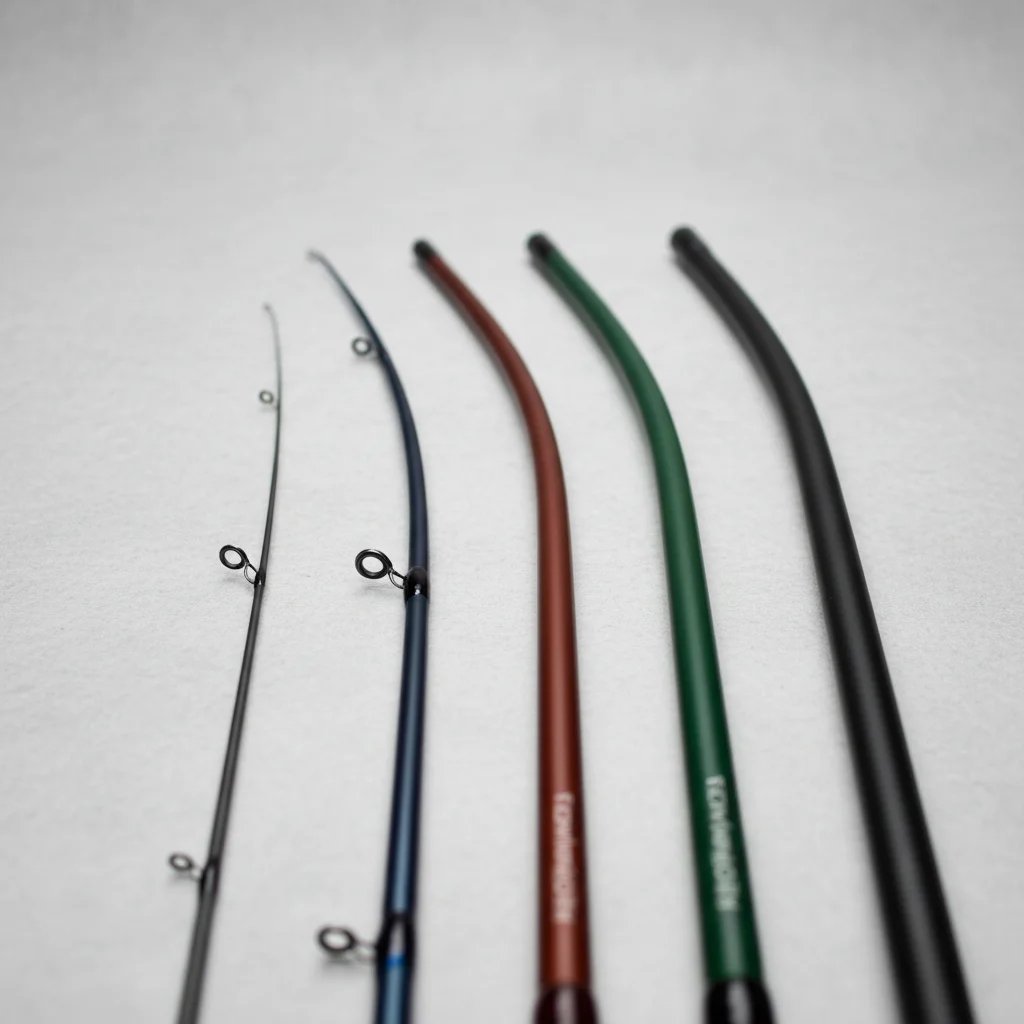
Fishing rod blanks come in a variety of actions, primarily categorized into four main types: extra-fast, fast, moderate-fast, and moderate. Understanding these actions is crucial for selecting the right blank for your fishing style and target species. The action of a rod blank refers to where along the blank it bends when pressure is applied to the tip. This characteristic directly impacts casting distance, accuracy, and the rod’s ability to fight a fish effectively.
Extra-Fast Action Blanks: Precision and Power
Extra-fast action blanks bend only in the very tip section. This design provides maximum sensitivity, allowing anglers to detect the subtlest bites. The stiff backbone of an extra-fast rod offers significant power for setting hooks quickly and controlling larger fish. These blanks are ideal for techniques requiring precise lure placement and immediate feedback, such as jigging or worm fishing for bass. However, their limited flex can make them less forgiving for beginners, potentially leading to pulled hooks if not handled correctly. For fishing rod buying guides on this site.
Fast Action Blanks: Versatility for Many Techniques
Fast action blanks bend in the top one-quarter to one-third of the rod. This action strikes a balance between sensitivity and flexibility, making them incredibly versatile for a wide range of fishing applications. Anglers often choose fast action rods for their ability to cast accurately while still providing enough give to absorb sudden runs from fish. They are excellent for spinnerbaits, topwater lures, and general-purpose fishing where a quick hook set is important but some shock absorption is also desired.
Moderate-Fast Action Blanks: Balanced Performance
|
Our Picks for the Best Fishing Rod in 2026
As an Amazon Associate I earn from qualifying purchases.
|
||
| Num | Product | Action |
|---|---|---|
| 1 | OKUMATrout Rod |

|
| 2 | PLUSINNO Fishing Rod and Reel Combos Carbon Fiber Telescopic Fishing Pole with Reel Combo Sea Saltwater Freshwater Kit Fishing Rod Kit |
|
| 3 | PLUSINNO Fishing Rod and Reel Combos - Carbon Fiber Telescopic Fishing Pole - Spinning Reel 12 +1 Shielded Bearings Stainless Steel BB |
|
| 4 | PLUSINNO Fishing Rod and Reel Combos - Carbon Fiber Telescopic Fishing Pole - Spinning Reel 12 +1 Shielded Bearings Stainless Steel BB |
|
| 5 | PLUSINNO Fishing Gear,Full Fishing kit Include Fishing Rod and Reel Combo, Tackle Box with Fishing Lures, Fishing Accessories, Fishing Pliers,Fishing Gifts for Men with Fishing Tool Kit |
|
| 6 | Shakespeare Micro Spinning Rod |
|
| 7 | PLUSINNO Fishing Rod and Reel Combos Carbon Fiber Telescopic Fishing Pole with Reel Combo Sea Saltwater Freshwater Kit Fishing Rod Kit |
|
| 8 | Sougayilang Fishing Rod Reel Combo with Telescopic Fishing Pole Spinning Reel Carrier Bag for Travel Saltwater Freshwater Fishing |
|
| 9 | Fishing Rod, 6.9ft 2Pcs Telescopic Fishing Rods Set, Carbon Fiber Fishing Pole, 2PCS Spinning Rod and Reel Combo with Carrier Bag Freshwater Fishing Rod and Reel Combos Kits Fishing Gear |
|
| 10 | PLUSINNO Fishing Rod and Reel Combos Carbon Fiber Telescopic Fishing Pole with Reel Combo Sea Saltwater Freshwater Kit Fishing Rod Kit |
|
Moderate-fast action blanks bend in the top one-half of the rod. This increased flexibility compared to fast action rods allows for longer casts, as the blank loads more deeply during the casting motion. They offer a good compromise between casting distance and fish-fighting power, making them suitable for crankbaits, larger topwater lures, and situations where a slightly slower hook set might be beneficial to prevent tearing hooks out of a fish’s mouth. The deeper bend also provides more cushion, reducing the chances of line breakage with lighter lines.
Moderate Action Blanks: Maximum Forgiveness and Casting Distance
Moderate action blanks bend throughout the top two-thirds or even three-quarters of the rod. These rods are known for their exceptional casting distance, as the entire blank works to propel the lure. The deep bend also provides maximum forgiveness, making them ideal for fishing with treble hooks, as the rod’s flex helps to keep fish pinned during the fight. They are commonly used for trolling, live bait fishing, and techniques where a softer presentation and a more parabolic bend are advantageous. While less sensitive than faster action rods, their ability to absorb shock is unmatched.
Choosing the Right Blank Action
Selecting the appropriate blank action depends heavily on your fishing style, target species, and preferred lures. Consider the following factors:
- Target Species: Smaller, more delicate fish often benefit from faster actions for sensitivity, while larger, harder-fighting fish might require the backbone of an extra-fast or the shock absorption of a moderate action.
- Lure Type: Lures with treble hooks (crankbaits, jerkbaits) often pair well with moderate actions to prevent tearing hooks. Single-hook lures (jigs, worms) benefit from faster actions for quick hook sets.
- Fishing Environment: Open water allows for longer casts, favoring moderate actions, while dense cover might require the precision and power of a faster action.
- Personal Preference: Ultimately, the best action is one that feels comfortable and effective in your hands. Experimentation can help you find your ideal match.
