Building a custom fishing rod at home is a rewarding endeavor that allows anglers to create a personalized tool optimized for their specific needs, offering enhanced sensitivity, balance, and aesthetics compared to off-the-shelf options. This DIY process, while meticulous, is achievable for beginners with the right guidance and a strong focus on safety, typically spanning several days due to epoxy curing times.
Essential Components for Your Custom Fishing Rod
Understanding the individual parts of a fishing rod is the first step in building one that meets your exact specifications. Each component plays a vital role in the rod’s overall performance.
Rod Blank: The Foundation of Performance
The rod blank is the cylindrical core of your fishing rod, dictating its action, power, and sensitivity. It’s the “skeleton” that everything else attaches to.
- Graphite: Known for being lightweight, incredibly sensitive, and offering fast action. Graphite blanks are excellent for detecting subtle bites and quick hook-sets, making them ideal for finesse fishing. However, they can be more brittle than other materials and often come with a higher price tag.
- Fiberglass: Offers exceptional durability, flexibility, and a more forgiving, slower action. Fiberglass rods are nearly indestructible and great for heavy-duty fishing or for beginners who need a more robust rod. They tend to be heavier and less sensitive compared to graphite.
- Composite (Graphite + Fiberglass): These blanks combine the best of both worlds, offering a balance of sensitivity, strength, and durability. Composite rods are versatile, suitable for a wide range of fishing techniques and environments.
Reel Seat: Securing Your Trusty Reel
The reel seat is where your fishing reel securely attaches to the rod. Its material and design impact the rod’s balance and comfort.
- Graphite Reel Seats: Lighter and generally more comfortable in cold weather, graphite seats are common on freshwater and lighter saltwater rods.
- Metal Reel Seats: More robust and durable, metal seats are typically found on heavy offshore rods designed for battling large species.
Handle and Grips: Your Connection to the Catch
The handle and grips are your primary contact point with the rod, influencing comfort, control, and how well you feel bites. Customization here is key to reducing fatigue and enhancing sensitivity.
- Cork: A classic choice, cork is lightweight, offers excellent sensitivity, and feels warm and natural in hand. High-quality cork can provide superior grip even when wet, though lower-grade cork may degrade over time.
- EVA Foam (Ethylene Vinyl Acetate): A modern favorite, EVA foam is durable, lightweight, water-resistant, and easy to clean. It holds up well in harsh conditions, including saltwater, and is very comfortable, though some anglers find it less sensitive than cork.
- Custom Wood or Composite: For a truly unique and personalized touch, custom wood or composite grips offer distinct aesthetics and a firm, solid feel. They can be precisely shaped to fit your hand, highlighting craftsmanship.
- Grip Styles: Common styles include full grips for maximum contact and split grips which reduce weight and expose more of the blank for increased sensitivity.
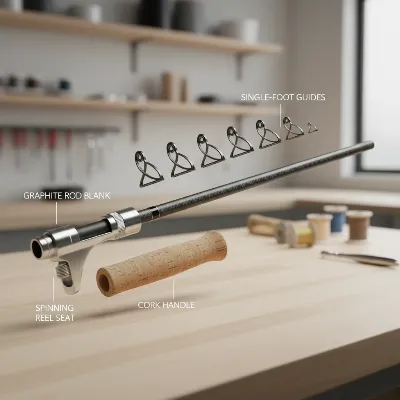 Detailed illustration of various custom fishing rod components including rod blank, reel seat, handle, and guides.
Rod Guides: Directing the Line with Precision
|
Our Picks for the Best Fishing Rod in 2026
As an Amazon Associate I earn from qualifying purchases.
|
||
| Num | Product | Action |
|---|---|---|
| 1 | PLUSINNO Fishing Rod and Reel Combos Carbon Fiber Telescopic Fishing Pole with Reel Combo Sea Saltwater Freshwater Kit Fishing Rod Kit |

|
| 2 | Sougayilang Fishing Rod Reel Combo with Telescopic Fishing Pole Spinning Reel Carrier Bag for Travel Saltwater Freshwater Fishing |
|
| 3 | Fishing Rod, 6.9ft 2Pcs Telescopic Fishing Rods Set, Carbon Fiber Fishing Pole, 2PCS Spinning Rod and Reel Combo with Carrier Bag Freshwater Fishing Rod and Reel Combos Kits Fishing Gear |
|
| 4 | OKUMATrout Rod |
|
| 5 | PLUSINNO Fishing Rod and Reel Combos - Carbon Fiber Telescopic Fishing Pole - Spinning Reel 12 +1 Shielded Bearings Stainless Steel BB |
|
| 6 | Shakespeare Micro Spinning Rod |
|
| 7 | PLUSINNO Fishing Rod and Reel Combos Carbon Fiber Telescopic Fishing Pole with Reel Combo Sea Saltwater Freshwater Kit Fishing Rod Kit |
|
| 8 | PLUSINNO Fishing Rod and Reel Combos - Carbon Fiber Telescopic Fishing Pole - Spinning Reel 12 +1 Shielded Bearings Stainless Steel BB |
|
| 9 | PLUSINNO Fishing Rod and Reel Combos Carbon Fiber Telescopic Fishing Pole with Reel Combo Sea Saltwater Freshwater Kit Fishing Rod Kit |
|
| 10 | PLUSINNO Fishing Gear,Full Fishing kit Include Fishing Rod and Reel Combo, Tackle Box with Fishing Lures, Fishing Accessories, Fishing Pliers,Fishing Gifts for Men with Fishing Tool Kit |
|
Rod guides are small rings mounted along the blank that control the line’s path, affecting casting distance, line friction, and sensitivity.
- Frame Materials:
- Stainless Steel: A durable and affordable option, but can groove over time, especially with braided line.
- Titanium: Lighter, stronger, and highly corrosion-resistant, titanium frames are ideal for saltwater rods and enhance sensitivity due to reduced weight.
- Carbon Fiber: The lightest frame material, carbon fiber guides maximize sensitivity and further reduce overall rod weight.
- Ring Inserts: These are the ceramic rings inside the frames that the line passes through.
- Aluminum Oxide (AlOx) / Alconite: Good balance of affordability and performance, reducing friction significantly compared to plain stainless steel. Alconite offers a finer grain structure for smoother performance.
- Silicon Carbide (SiC): A high-end ceramic known for exceptional hardness, heat resistance, and smoothness, minimizing line wear and allowing for longer casts.
- Torzite: Considered a premium insert, Torzite is thinner, lighter, and smoother than SiC, further enhancing line flow and sensitivity.
- Guide Types:
- Single-Foot Guides: Have one leg attaching to the blank, making them lightweight and popular for lighter rods where sensitivity is key.
- Double-Foot Guides: With two legs, these provide increased strength and durability, suitable for heavier rods and larger fish.
- Triple-Foot Guides: Offer maximum support and strength, typically used on very heavy-duty rods for deep-sea or surf fishing.
Tip-Top: The Final Touch
The tip-top is the last guide at the very end of your rod blank, completing the guide train. It needs to be durable and smooth to handle line friction.
Important Factors When Building a Custom Fishing Rod
Crafting a custom fishing rod involves making thoughtful choices that go beyond aesthetics, directly impacting its performance on the water.
Rod Length: Casting Distance vs. Control
The length of your rod significantly influences its casting distance and maneuverability.
- Shorter Rods (under 7 feet): Excellent for accuracy and control in tight spaces like dense brush or kayak fishing. They also provide more leverage for fighting fish up close.
- Longer Rods (7 feet and up): Ideal for achieving maximum casting distance and covering more water, especially useful for surf fishing or open water scenarios.
Rod Power (Weight Rating): Matching Your Catch
Rod power, also known as its weight rating, refers to the rod’s stiffness or how much force is required to bend it.
- Light (L) / Ultra-Light (UL): Designed for smaller fish and lighter lines, offering maximum sensitivity for detecting subtle bites.
- Medium (M) / Medium-Heavy (MH): Versatile options for a wide range of species and techniques, providing a good balance of sensitivity and fighting power.
- Heavy (H) / Extra-Heavy (XH): Built for large, powerful fish and heavy lines, offering immense backbone for brute force battles.
Rod Action: Where the Rod Bends
Rod action describes where along the blank the rod bends when under pressure, influencing responsiveness and casting style.
- Fast Action: Bends primarily in the top third of the rod. This provides quick responsiveness, excellent sensitivity for feeling bites, and powerful hook-sets. Ideal for techniques requiring precision.
- Moderate Action: Bends in the top half of the rod, offering a more parabolic curve. This action is versatile, good for casting lighter lures, and provides a softer feel that can absorb sudden shocks from larger fish.
- Slow Action: Bends throughout the entire length of the rod. Slow action rods are very forgiving, ideal for protecting light lines and preventing hooks from tearing out of a fish’s mouth, often used for live bait or slow presentations.
Matching Components for Optimal Performance
The synergy between all components is critical. A perfectly balanced custom rod means that the blank’s power and action are complemented by the right reel seat, handle, and guides. For instance, an ultra-light blank paired with heavy, oversized guides would negate its sensitivity and balance. Ensure that the diameter of your grips and reel seat matches or can be appropriately reamed to fit your chosen rod blank without excessive gaps.
Essential Tools and Supplies for DIY Rod Building
Embarking on your rod building journey requires a specific set of tools and consumables to ensure precision, durability, and a professional finish. Many of these can be found in beginner-friendly rod building kits.
Basic Setup and Measurement
- Rod Building Assembly Bench/Hand Wrapper: A crucial tool to securely hold and slowly rotate the rod blank while you attach components and wrap guides. A hand wrapper allows for manual rotation, while a power wrapper provides motorized rotation for consistency, especially during finish application.
- Reamers: Abrasive tools used to enlarge and shape the inner diameter of grips and handle components to ensure a snug fit on your rod blank.
- Digital Calipers & Tape Measure: For precise measurements of blank diameters, component lengths, and guide spacing.
- White China Marker/Grease Pencil: Used to mark guide placements, reel seat positions, and the rod’s spine without permanently damaging the blank.
Adhesives and Finishes
- Two-Part Epoxy Glue (for components): A strong, slow-setting adhesive used to permanently bond the reel seat, grips, and butt cap to the rod blank. It typically has a longer working time, allowing for adjustments.
- Two-Part Thread Finish Epoxy (for wraps): A specialized clear, flexible epoxy that cures to a hard, glossy finish over your guide wraps, protecting the threads from water, UV light, and abrasion. It requires precise mixing.
- Tip-Top Adhesive: Often a heat-sensitive glue stick or 5-minute epoxy used to attach the tip-top guide.
- Denatured Alcohol/Methylated Spirits: Essential for cleaning excess epoxy, preparing surfaces, and cleaning brushes.
Wrapping and Finishing Tools
- Wrapping Thread: Durable nylon or traditional silk thread in various colors for securing guides and decorative wraps. Nylon is popular for its strength and color range.
- Razor Blades/Small Scissors: For precise cutting of wrapping thread.
- Thread Burnishing Tool: A plastic or metal tool used to gently push and tighten thread wraps, removing gaps and ensuring a smooth, even finish.
- Finishing Brushes: Small, disposable brushes for applying epoxy finish evenly over thread wraps.
- Alcohol Burner/Heat Gun: Used to gently warm thread finish epoxy to thin it, allowing it to flow more smoothly and to pop any air bubbles, creating a crystal-clear coat.
- Rod Drying Motor with Supports: A slow-turning motor that rotates the rod continuously for several hours while the epoxy finish cures, preventing drips and ensuring an even, consistent coat.
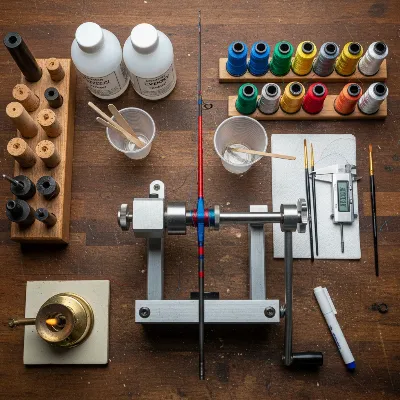 Assortment of essential DIY fishing rod building tools laid out on a workbench, including a hand wrapper, reamers, epoxy, and thread.
Step-by-Step Guide to Building Your Custom Rod
Building a custom fishing rod at home is a meticulous process that requires patience and attention to detail. Always prioritize safety by working in a well-ventilated area and wearing appropriate personal protective equipment (PPE), such as gloves and safety glasses, especially when handling epoxies and solvents. Always follow the manufacturer’s safety guidelines for any chemicals used.
1. Prepare the Blank and Find the Spine
- Inspect and Clean: Carefully inspect your rod blank for any imperfections. Clean the blank thoroughly with denatured alcohol to remove any oils or dust.
- Find the Spine: Every rod blank has a natural bend or “spine” – its stiffest side. Properly orienting the spine is crucial for optimal casting performance and accuracy.
- Method: Hold the butt end of the blank on the floor and gently bend the tip with your other hand, slowly rotating the blank. You’ll feel a point where the blank resists twisting and wants to settle into a specific orientation. This is the spine. Mark the spine (or the opposite side for spinning rods, depending on preference) with your china marker. For multi-piece rods, find the spine on each section.
2. Install the Handle and Reel Seat
- Ream Grips: Use reamers to carefully enlarge the inner diameter of your chosen grips and reel seat until they slide snugly onto the blank without being too tight or loose. Avoid removing too much material.
- Create Arbors: For the reel seat, use masking tape to create “arbors” – small wraps of tape around the blank at the front and back of where the reel seat will sit. These arbors ensure the reel seat is centered and provide a solid surface for the epoxy to bond.
- Apply Epoxy: Mix your two-part component epoxy thoroughly according to the manufacturer’s instructions. Apply a thin, even coat to the blank where the grips and reel seat will be, ensuring the arbors are covered.
- Assemble: Slide the butt cap, rear grip, reel seat, and foregrip (if applicable) onto the blank, aligning the reel seat’s hoods with your spine marks. Clean off any excess epoxy immediately with denatured alcohol. Allow to cure completely.
3. Mount the Tip-Top
- Size Check: Ensure your tip-top fits snugly onto the very tip of the rod blank.
- Apply Adhesive: Apply a small amount of tip-top adhesive (thermal glue stick, heated with an alcohol burner, or 5-minute epoxy) to the tip of the blank.
- Install and Align: Push the tip-top onto the blank, aligning its ring with the spine mark you made earlier. You can gently reheat thermal glue to adjust alignment if needed before it hardens.
4. Determine Guide Spacing and Placement
- Temporary Setup: Temporarily attach your reel to the newly installed reel seat. Thread your fishing line through the tip-top.
- Attach Guides: Place your guides along the blank, temporarily securing them with small pieces of masking tape or guide tubing.
- Stress Test for Alignment: With the line threaded through all guides, gently bend the rod into a 90-degree curve (a “critical angle”) by having someone hold the tip or by anchoring the butt. Observe how the line runs through the guides. The line should follow a smooth, unbroken arc, staying clear of the blank. Adjust guide positions until the line runs perfectly smooth and there are no sharp angles or contact points with the blank itself. Mark these final positions with your china marker.
5. Wrap the Guides
- Prepare Guides: Gently file the feet of each guide smooth to create a seamless transition for the wrapping thread.
- Start Wrapping: Place the rod blank on your hand wrapper. Start your thread wrap a few millimeters before the guide foot, making several overlapping turns to secure the starting end. Pull the tag end tight and trim it flush.
- Wrap Over the Foot: Carefully rotate the rod, wrapping the thread tightly and evenly over the guide foot. Use your burnishing tool to nudge any gaps in the thread.
- Locking Wrap: As you approach the end of the wrap, insert a small loop of thread (created from a separate piece of thread) under your working thread, pointing towards the guide. Continue wrapping over the loop for a few turns. Feed the working thread’s tag end through this loop, then pull the loop from the opposite end, drawing the working thread securely underneath the final wraps. Trim the excess flush. Repeat this for all guides.
6. Apply Thread Finish (Epoxy Coating)
- Mix Epoxy: Mix your two-part thread finish epoxy precisely according to the manufacturer’s 50/50 ratio. Inaccurate mixing will result in a tacky or uneven cure.
- Apply First Coat: Place the rod on your drying motor. Use a small finishing brush to apply a thin, even coat of mixed epoxy over each thread wrap. Ensure full saturation of the thread.
- Remove Bubbles: Gently pass an alcohol burner flame or heat gun over the wet epoxy. The heat thins the epoxy, allowing it to self-level and releasing any trapped air bubbles, creating a clear, smooth finish. Keep the heat source moving to avoid overheating.
- Cure: Allow the rod to rotate on the drying motor for 4-6 hours (or as recommended by epoxy manufacturer) to ensure an even cure. For a deeper, more durable finish, apply a second coat after the first has partially cured (usually 12-24 hours later).
7. Inscribe Your Rod
- Personalize: Once the epoxy wraps are fully cured (after the first coat if you plan multiple, or before the final one), you can use a fine-tipped gel pen or specialized ink to inscribe your name, the date, or any other personal details onto the blank. This adds a unique touch to your custom fishing rod.
8. Final Cure
- Patience is Key: Allow your custom fishing rod to cure completely for 1-2 days (or as specified by your epoxy) before taking it out for its maiden voyage. This ensures maximum durability and hardness of the finish.
Conclusion
Building your own custom fishing rod is an incredibly rewarding endeavor that combines craftsmanship with the passion for angling. From the tactile satisfaction of selecting each component to the meticulous process of assembly and the final proud cast, a custom-built fishing rod is more than just a tool—it’s an extension of your spirit on the water. By following these steps and prioritizing safety, you can create a high-performance, personalized fishing rod that will enhance your angling experiences for years to come. So, gather your tools, choose your components, and embark on this journey to craft your ultimate angling companion. What will your first custom fishing rod help you catch?
Frequently Asked Questions
Is building a custom fishing rod difficult for beginners?
While it involves several precise steps, building a custom fishing rod is not inherently difficult for beginners, especially when starting with a rod-building kit. These kits often provide all necessary components and basic tools, making the process much more manageable. Patience and attention to detail are more important than prior experience.
How long does it take to build a custom fishing rod?
The actual hands-on building time for a custom fishing rod can vary from a few hours to a full day. However, much of the process involves waiting for epoxy to cure, which can take 12-24 hours per coat, plus a final curing period of 1-2 days. So, while active work is short, the overall project usually spans several days.
What is the most crucial step in custom rod building?
Finding the “spine” of the rod blank and properly aligning all components, especially the guides and reel seat, is arguably the most crucial step. Correct spine orientation ensures optimal casting performance and responsiveness, directly impacting the rod’s feel and efficiency on the water.
Can a custom-built rod be used for any type of fishing?
Yes, a key advantage of building a custom rod is tailoring it precisely for a specific type of fishing, target species, or personal fishing style. By carefully selecting the blank material, action, power, length, and components, you can design a rod optimized for anything from ultra-light freshwater finesse to heavy-duty saltwater big game.
What safety precautions should I take when building a fishing rod at home?
Always work in a well-ventilated area to avoid inhaling fumes from epoxies and solvents. Wear personal protective equipment (PPE) such as safety glasses to protect your eyes from debris and chemical splashes, and disposable gloves to prevent skin contact with epoxies and glues. Always read and follow the safety guidelines provided by the manufacturers of all chemical products.

This was a great resource for getting started. I appreciated the emphasis on safety and the breakdown of each component. The epoxy curing times did make it a multi-day project, as mentioned, but the end result feels so much more balanced than any store-bought rod I’ve used. I’m already planning my next build!
Good overview for beginners, but I found some of the steps a little vague when it came to the actual wrapping process. I had to look up a few extra videos to get a clear idea of how to properly secure the guides. The concept of enhanced sensitivity is definitely there, but the DIY process felt a bit more meticulous than I anticipated.
I’ve always wanted to try building my own rod, and this guide was super helpful. The section on choosing the right rod blank, especially the graphite options, really clarified what I needed for the kind of bass fishing I do. My first attempt turned out way better than I expected, and the sensitivity is incredible. Definitely worth the time investment for a personalized tool.
Finally got around to building a custom rod after reading this. The explanation of how each component plays a vital role really helped me understand the ‘why’ behind each choice. My new rod has amazing aesthetics and feels perfectly optimized for my specific needs. It’s a rewarding endeavor for sure.